
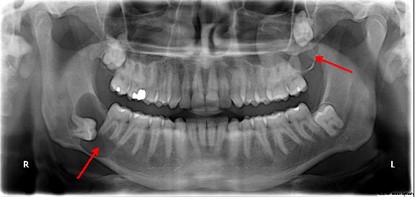
What Is a Jaw Cyst?
Various cysts, either originating from a tooth or forming independently, can occur in the jaws. These cysts can sometimes reach quite large sizes without being noticed by the patient. For this reason, a panoramic dental X-ray is recommended during regular dental check-ups.
Jaw cysts are usually of dental origin and form around the tooth root. If left untreated, they can grow and lead to serious problems. In patients with a cyst at the tooth root, extracting the tooth alone is not sufficient treatment. If the cyst is left in the bone, it continues to grow and can cause bigger problems. In this case, more than one tooth may need to be extracted. Therefore, when cystic structures are detected, they must be completely removed surgically.
What are the symptoms of jaw cysts?
Jaw cysts can sometimes present with symptoms such as pain, swelling or tooth sensitivity. In some cases, however, they can progress considerably without being noticed by the patient.
Odontogenic cysts are generally benign and progress slowly. However, if they are not treated in time, they can damage critical anatomical structures such as the sinuses, the nasal cavity or nerves, or carry a risk of turning into malignant tumours.
How is jaw cyst surgery performed?
Root canal treatment may first be applied to the teeth identified as being related to the cyst. The area is then numbed with local anaesthesia, the gum is carefully lifted and the cyst is reached. The cyst is completely cleaned out and the area is closed with sutures. While healthy bone is left to heal naturally, bone graft powder may be used in some cases to speed up healing. The tissue removed during surgery may need to be examined by a pathologist.
If the cyst is large or located in sensitive areas, the procedure can be performed under sedation or general anaesthesia. In this case, the most suitable method is determined by the doctor.
Is jaw cyst surgery painful, and what happens afterwards?
The operation is performed painlessly with effective local anaesthesia. Afterwards, the antibiotics, painkillers and antiseptic mouthwashes recommended by the doctor must be used. Mild swelling is possible, but it can be kept under control.
If cysts related to nerve tissue are removed, temporary numbness may be experienced. This usually improves over time, and the benefits of removing the cyst are far greater than these risks.
Get information about this treatment
Leave your number and we will call you, or write to us on WhatsApp.